Sivacrypticus: Difference between revisions
No edit summary |
No edit summary |
||
| (8 intermediate revisions by the same user not shown) | |||
| Line 2: | Line 2: | ||
__NOTOC__ | __NOTOC__ | ||
<div style="float:right; margin-left:1em;"> | <div style="float:right; margin-left:1em;"> | ||
[[File:Sivacrypticus habitus.jpg|thumb|400px|''Sivacrypticus | [[File:Sivacrypticus habitus.jpg|thumb|400px|''Sivacrypticus taiwanicus'', habitus]] | ||
<div style="clear:right;"> | <div style="clear:right;"> | ||
{{TaxoboxNoFamily | {{TaxoboxNoFamily | ||
| Line 14: | Line 14: | ||
</div> | </div> | ||
</div> | </div> | ||
''Sivacrypticus'' is the only genus of the family '''Archeocrypticidae''' (cryptic fungus beetles) occurring in Taiwan | ''Sivacrypticus'' is the only genus of the family '''Archeocrypticidae''' (cryptic fungus beetles) occurring in Taiwan. | ||
Archaecrypticidae is a small family of Tenebrionoidea, recent papers revealed it as sister to Ulodidae<sup>[[#ref1|[1]]]</sup>, to Ulodidae + Chalcodruidae + Promecheidae<sup>[[#ref2|[2]]]</sup>, or to Anthicidae + Ischaliidae + Meloiidae<sup>[[#ref3|[3]]]</sup>. | |||
== Occurrence in | A single species ''S. taiwanicus'' Kaszab, 1964 is recorded from Taiwan. The species was described from the materials collected by Hans Sauter in ‘Pilam’ (= Beinan township, Taitung County, southern Taiwan) <sup>[[#ref4|[4]]]</sup>and are deposited in Museum of Natural History in Budapest, Hungary. Only females were known, male genitalia were only documented based on specimens from this project<sup>[[#ref5|[5]]]</sup> - they indicate that ''S. taiwanicus'' is very similar to ''S. philippinus'' Merkl,1988 from Luzon (Philippies)<sup>[[#ref6|[6]]]</sup>. | ||
The species is locally common in lowland forests in southern and central Taiwan. | |||
== Occurrence in Taiwan == | |||
The species is locally common in leaf litter of lowland forests in southern and central Taiwan. | |||
== Species == | == Species == | ||
* ''Sivacrypticus | * ''Sivacrypticus taiwanicus'' Kaszab, 1964 | ||
== Photos == | == Photos == | ||
<gallery widths=" | <gallery widths="180px" heights="150px"> | ||
File:Sivacrypticus genitalia.jpg|Male genitalia of ''Sivacrypticus | File:Sivacrypticus genitalia.jpg|Male genitalia of ''Sivacrypticus taiwanicus'' | ||
File:Sivacrypticus_taiwanicus_HT.jpg|Holotype of ''Sivacrypticus taiwanicus'' | |||
File:Sivacrypticus taiwanicus PT.jpg|Paratype of ''Sivacrypticus taiwanicus'' | |||
</gallery> | </gallery> | ||
== References == | == References == | ||
Latest revision as of 10:49, 7 May 2026

| Scientific classification | |
|---|---|
| Kingdom | Animalia |
| Phylum | Arthropoda |
| Class | Insecta |
| Order | Coleoptera |
| Suborder | Polyphaga |
| Superfamily | Tenebrionoidea |
| Family | Archeocrypticidae |
| Genus | Sivacrypticus Kaszab, 1964 |
Sivacrypticus is the only genus of the family Archeocrypticidae (cryptic fungus beetles) occurring in Taiwan.
Archaecrypticidae is a small family of Tenebrionoidea, recent papers revealed it as sister to Ulodidae[1], to Ulodidae + Chalcodruidae + Promecheidae[2], or to Anthicidae + Ischaliidae + Meloiidae[3].
A single species S. taiwanicus Kaszab, 1964 is recorded from Taiwan. The species was described from the materials collected by Hans Sauter in ‘Pilam’ (= Beinan township, Taitung County, southern Taiwan) [4]and are deposited in Museum of Natural History in Budapest, Hungary. Only females were known, male genitalia were only documented based on specimens from this project[5] - they indicate that S. taiwanicus is very similar to S. philippinus Merkl,1988 from Luzon (Philippies)[6].
Occurrence in Taiwan
The species is locally common in leaf litter of lowland forests in southern and central Taiwan.
Species
- Sivacrypticus taiwanicus Kaszab, 1964
Photos
-
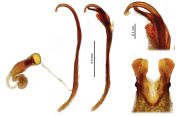 Male genitalia of Sivacrypticus taiwanicus
 -
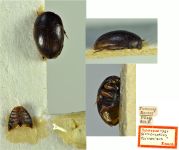 Holotype of Sivacrypticus taiwanicus
 -
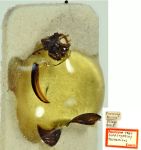 Paratype of Sivacrypticus taiwanicus


